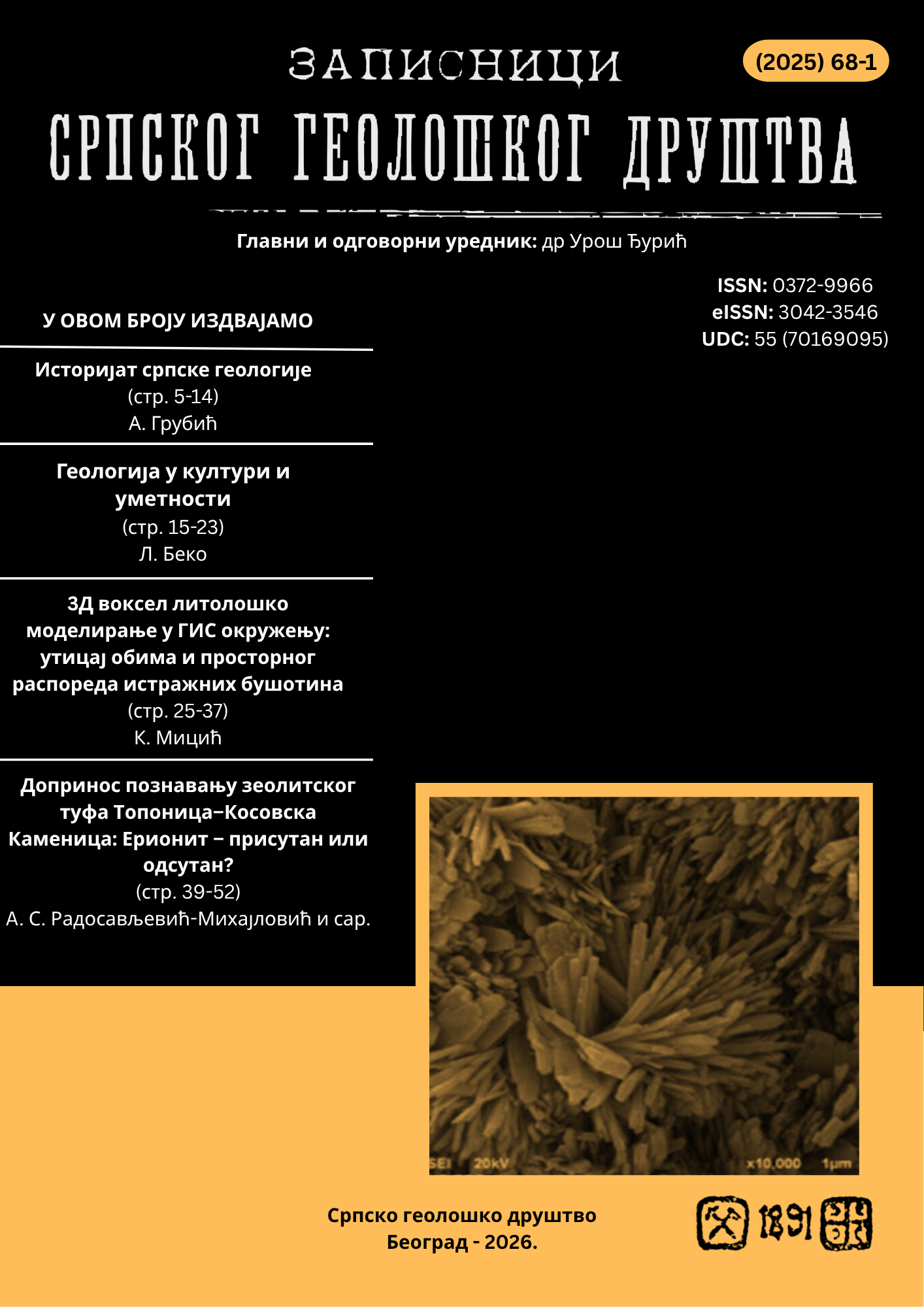
Contribution to the Knowledge of Zeolitic Tuff Toponica–Kosovska Kamenica: Erionite – Present or Absent?
DOI:
https://doi.org/10.5281/zenodo.18879241Keywords:
zeolitic tuff, clinoptilolite, erionite, cation exchange capacityty, XRPDAbstract
This paper presents new results of the mineralogical and crystallographic analysis of zeolitic tuff from the Toponica deposit, located in the eastern part of Kosovo. The geological structure of the deposit consists of a basal layer of Miocene clay sandstone, followed by a horizon of white zeolitic tuff, and an overlying layer of Miocene shales, clay, and gravel. Quantitative X-ray diffraction analysis of the examined sample identified the following mineral phases: heulandite 80.1%, quartz 0.15%, erionite 4.0%, muscovite 5.4%, albite 7.7%, orthoclase 1.0%, and calcite 1.0%. The analytical procedures applied in the study included powder X-ray diffraction (XRPD) on a polycrystalline sample, SEM/EDS analysis, and optical microscopy. The cation exchange capacity of the zeolitic tuff is 140 meq/100 g, classifying this mineral raw material as a high-quality resource suitable for application in various industries.
Downloads
Published
How to Cite
Issue
Section
Categories
License
Copyright (c) 2026 Ana Radosavljević-Mihajlović, Katarina Mihajlović, Ivana Jelić, Slavica Mihajlović, Jovica Stojanović, Vladan Kašić, Nikola Vuković

This work is licensed under a Creative Commons Attribution 4.0 International License.
This license enables reuse to distribute, remix, adapt, and build upon the material in any medium or format, so long as attribution is given to the creator.
The license allows for commercial use.
CC BY includes the following elements:
BY: credit must be given to the creator.